To choose the right LED high bay for a new warehouse or manufacturing facility, you must look beyond “lumen output” and “fixture reliability.” While brightness and durability are standard in 2026, the most critical factor for modern builds is integrated intelligence. Specifying high bays with integrated motion sensors allows for a 15–20% Capex investment that typically yields a 100% ROI within 6 months through 50%+ energy savings, all without the need for additional control wiring or complex central systems.
AdvanLED Sensor LED High Bays
Beyond the Commodity: Why “Smart” High Bays are the Highest ROI Spec
When planning a new warehouse, lighting is often treated as a late-stage commodity—a simple line item to be checked off. The prevailing logic among consultants and building owners is that because LED technology has matured, any reliable fixture will do.
However, treating lighting as a simple “on/off” utility is an expensive mistake that locks in high operating costs for years. By specifying Integrated Sensor High Bays during the design phase, you transition from a “standard” build to a high-efficiency asset with a negligible impact on initial Capex.
The Barrier: Debunking the “Complex Controls” Myth
The primary reason project managers shy away from smart lighting is the fear of complexity. Historically, “smart” meant centralized control hubs, specialized proprietary software, and miles of additional low-voltage data wiring.
The modern reality is different:
Zero Additional Rewiring: Integrated sensors live within the fixture itself. They utilize the existing power leads. No extra copper, no additional labor, and no specialized contractors are required.
Group Logic without Software: Modern fixtures allow for easy grouping (zoning) via simple remote or app-based commissioning. This means lights in the same aisle can act in unison without a master computer.
Capex Efficiency: Transitioning from a standard LED to a sensor-integrated smart LED typically only adds 15–20% to the lighting budget—a fraction of the total project cost that is often offset by energy rebates or tax incentives.
The Math: A 1-Year ROI Case Study
The true “Information Gain” lies in the occupancy data. In a typical 24/7 or double-shift operation, up to 70% of warehouse aisles are unoccupied at any given time. Traditional lights burn 100% power in 0% traffic.
Let’s look at the real-world savings of a single 200W LED High Bay using integrated sensors:
Variable
Standard LED High Bay
Smart Sensor High Bay
Power Rating
200W (Constant)
200W (Peak) / 20W (Dimmed)
Average Usage
100% Power
30% Active / 70% Dimmed
Effective Daily Load
2.4 kWh (12 hrs)
0.88 kWh (12 hrs)
Annual Operating Cost
RM 360.00
RM 132.00
Annual Savings
–
RM 228.00 per fixture
Note: Based on 12 hours/day, 300 days/year, at RM 0.50/kWh.
When you consider that the price difference for the sensor is often less than RM 100 per unit, the ROI is achieved in under 6 months. For a 100,000 sq. ft. facility, this translates to tens of thousands of Ringgit in annual OpEx reclaimed.
Strategic Benefits for Consultants and Owners
Specifying smart lighting isn’t just about electricity; it’s about future-proofing the asset.
Compliance & Green Ratings: Meeting increasingly strict energy codes (like GBI or LEED) becomes effortless when every light is an intelligent node.
Safety & Zoning: Instead of a pitch-black warehouse, sensors allow for “corridor logic”—dimming lights to a 10% safety level rather than turning them off, then instantly ramping to 100% when motion is detected.
Extended Lifespan: LEDs last longer when they aren’t running at 100% heat capacity around the clock. Dimming significantly reduces the thermal load on the driver and COB.
Conclusion: Spec-In for Success
The window to maximize ROI is during the planning phase. Once the “dumb” fixtures are ordered and the wiring is finalized, the cost to upgrade doubles.
Are you designing a new warehouse or manufacturing floor? Don’t settle for a commodity build. Let us help you review your floor plans to spec-in a lighting system that pays for itself before the first year of operation is over.
The latest technology in LED Tube and LED T8 design centers on achieving Ultra-High Efficacy (UHE) of up to 200lm/W, allowing a drop from 18W to 11W for the same light output.
Another major breakthrough is Bluetooth Mesh Grouping, which eliminates the “disco effect” of isolated sensors by networking tubes into unified zones.
Furthermore, modern tubes now feature Smart ESG Integration with internal chips for real-time energy monitoring and arrive with Factory-Preset Installation for a true plug-and-play experience.
The “Developer Standard” vs. True Efficiency
A common challenge in residential and commercial developments is that the lighting is often pre-installed by developers who prioritize initial construction costs over long-term operational efficiency. In many cases, these buildings are fitted with standard or “entry-level” LED T8 tubes that barely meet minimum requirements. Owners and facility managers often inherit a system that is far from the highest efficiency available on the market, meaning they are overpaying for energy from day one without even realizing it.
If your building was delivered with “standard” LEDs, you are likely using tubes that operate at a much lower efficacy than today’s LED Tube benchmarks. Transitioning from these developer-grade installations to 200lm/W technology isn’t just a maintenance update—it’s a necessary correction that fixes the efficiency gap built into the property’s original design.
The Hidden Cost of “Legacy” LED T8 Systems
Many facility managers believe their lighting maintenance is a solved problem because they transitioned to LED five or more years ago. However, the industry is currently facing a silent crisis of lumen depreciation and driver fatigue. While these first-generation LED Tube retrofits might still be operational, they are likely hitting their L70 limit, meaning they have lost roughly 30% of their original brightness while still consuming a full 18W of power. This “Efficiency Debt” is a significant drain on operational budgets that often goes unnoticed until light levels drop to unsafe levels.
Upgrading to the modern 200lm/W LED T8 standard fundamentally changes the financial equation. By switching from legacy 18W tubes to high-performance 11W units, you are not just maintaining your facility; you are slashing your lighting energy bill by nearly half again on top of your original LED savings. These new tubes use advanced frosted diffusion and thermal management to ensure that light quality remains superior without the harsh glare common in older high-output models.
Eliminating the “Disco Effect” Through Bluetooth Mesh Grouping
One of the most persistent tenant complaints in large carparks and common areas is the “haunted house” or “disco” effect. This occurs when standalone PIR sensors trigger individual LED T8 tubes one at a time as a person or vehicle moves through a space. This fragmented lighting response feels jittery and unsafe, often creating dark pockets between active sensors. It is a limitation of hardware that facility managers have simply learned to live with, but it is no longer necessary.
The latest technology solves this through Bluetooth Mesh Grouping. Instead of acting as isolated units, the LED Tube network is synchronized so that a single trigger point wakes up an entire zone instantly. This creates a high-end, uniform “carpet of light” that moves with the tenant, significantly enhancing the sense of security. Because the response is so reliable, managers can afford to be more aggressive with energy-saving settings, such as shorter hold times and lower idle dimming levels, without ever leaving a user in the dark.
Scaling Smart Solutions with Plug-and-Play Simplicity
The primary barrier to adopting smart lighting has traditionally been the complexity and cost of onsite commissioning. In the past, “smart” meant hiring specialized engineers to spend days configuring software and pairing devices. The current generation of LED T8 technology has moved this complexity to the factory floor. These systems arrive factory-preset, with every tube labeled for a specific zone according to a pre-designed layout plan.
The installation process is now as simple as a standard retrofit. The contractor installs the tube according to the provided map, and the units automatically form a secure Bluetooth mesh network the moment power is applied. This removes the risk of software hurdles and ensures that the system is operational from day one. This streamlined approach allows large facilities to transition to sophisticated smart lighting with the same labor costs as a basic tube replacement.
Transforming Lighting into a Strategic ESG Asset
For years, facility managers have struggled to provide verified data for sustainability audits, often relying on theoretical math based on broad utility bills. Modern LED T8 units change this by integrating energy monitoring chips directly into the hardware. These chips track actual wattage consumption in real-time and transmit the data via a Bluetooth gateway to a centralized dashboard.
This capability turns your lighting infrastructure into a powerful tool for ESG and sustainability reporting. Instead of guessing, building owners can now visualize exact energy performance and export verified data to prove carbon footprint reductions. This level of transparency is becoming essential for LEED, GreenRE, GBI, GRESB, and other high-level certifications, positioning the facility manager as a key player in the organization’s corporate governance goals.
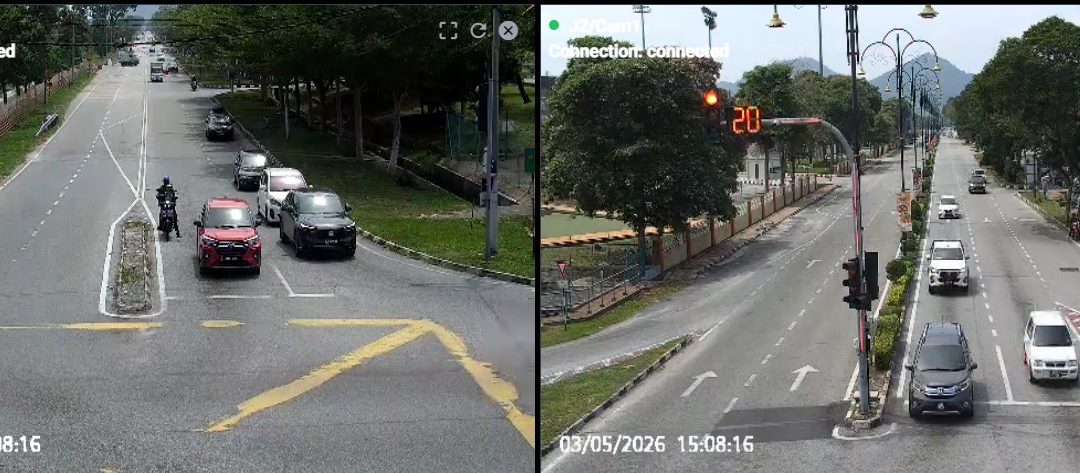
How do you solve traffic congestion on a corridor that has reached physical capacity without widening the road? In Manjung, Perak, our smart traffic management system, AdvanCTi Traffic, reduced journey times by 15-25% on a heavily congested corridor. By replacing static timers with AI-driven CCTV vision, AdvanCTi Traffic recalculates a Dynamic Greenwave every cycle. Using established traffic engineering principles like the Webster formula and Maxband optimization, it clears residual queues in real-time and prevents the intersection deadlocks caused by excessive 180-second cycle times.
The Challenge: When Standard Traffic Timers Fail
For municipal councils and JKR engineers, adopting smart city infrastructure requires proven reliability. You cannot afford to make your city a testing ground for experimental technology.
Our recent deployment in Manjung addressed a common but critical issue: severe junction-to-junction bottlenecks. Vehicles were frequently trapped at consecutive traffic lights because the intersections were not communicating.
Local consultants had already attempted multiple manual timing adjustments. The prevailing conclusion was that the physical capacity of the road was “maxed out,” and the traffic condition was impossible to improve without costly civil engineering and road widening.
Expert Insight: Why Increasing Cycle Time to 180s Causes Deadlocks
When intersections fail, the traditional reflex is to increase the cycle time. However, field data and human behavioral psychology prove this is counterproductive.
Pushing a cycle time beyond 180 seconds does not clear the backlog. Instead, wait times exceeding three minutes lead to severe driver impatience. Drivers begin forcing their way into the intersection on yellow or red, resulting in intersection blocking and gridlock (deadlock). The solution isn’t longer green lights; it is highly synchronized, intelligent green lights.
The Solution: Engineering-Backed AI Vision with AdvanCTi Traffic
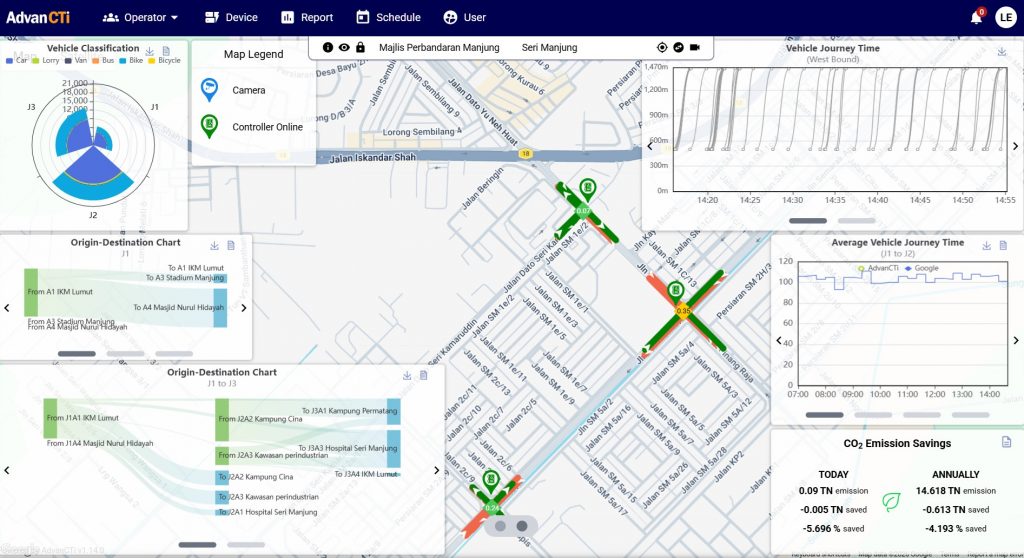
AdvanCTi Traffic Dashboard
Many vendors offer “smart CCTV” for traffic counting, but high-definition cameras are ineffective without sound traffic engineering processing the data. AdvanCTi Traffic in Manjung integrated real-time AI vision with proven, mathematically sound traffic engineering.
Here is how AdvanCTi Traffic safely optimizes traffic flow:
Real-Time Granular Data: Our edge-computing CCTV units continuously capture live metrics—including precise vehicle counts, directional flow, waiting times, queue residuals, and vehicle classification.
Dynamic Greenwave Synchronization: Instead of relying on historical averages or time-of-day (TOD) plans, the AdvanCTi Traffic advanced algorithm recalculates the Greenwave on every single cycle. It anticipates the arriving platoon of vehicles and adjusts the downstream lights accordingly.
Rooted in Established Science: Our artificial intelligence is constrained and guided by established frameworks, specifically the Webster formula and Maxband optimization. This ensures that the AI’s decisions are fundamentally safe, predictable, and aligned with JKR standards.
The Results: Proven, Measurable Impact in Manjung
The AdvanCTi Traffic installation successfully transformed a gridlocked corridor into a flowing arterial road, proving that software and intelligent synchronization can solve hardware (road capacity) limitations. The measurable outcomes include:
15% to 25% Reduction in Journey Time: Commute times across the entire synchronized corridor dropped significantly.
Elimination of Intersection Deadlocks: By dynamically clearing residual queues, we prevented the spillback that causes gridlock.
Zero Infrastructure Expansion: We unlocked up to 25% more road capacity without moving a single curb or widening the physical road, saving massive civil engineering costs.
Ready to Upgrade Your Traffic Infrastructure?
Your municipal council does not need to take risks on unproven tech. Implement AdvanCTi Traffic, a system backed by real-time data, established engineering formulas, and proven operational success in Manjung.