PRODUCTS / SIMON LED LIGHTING / WP26 LED Waterproof Batten Light

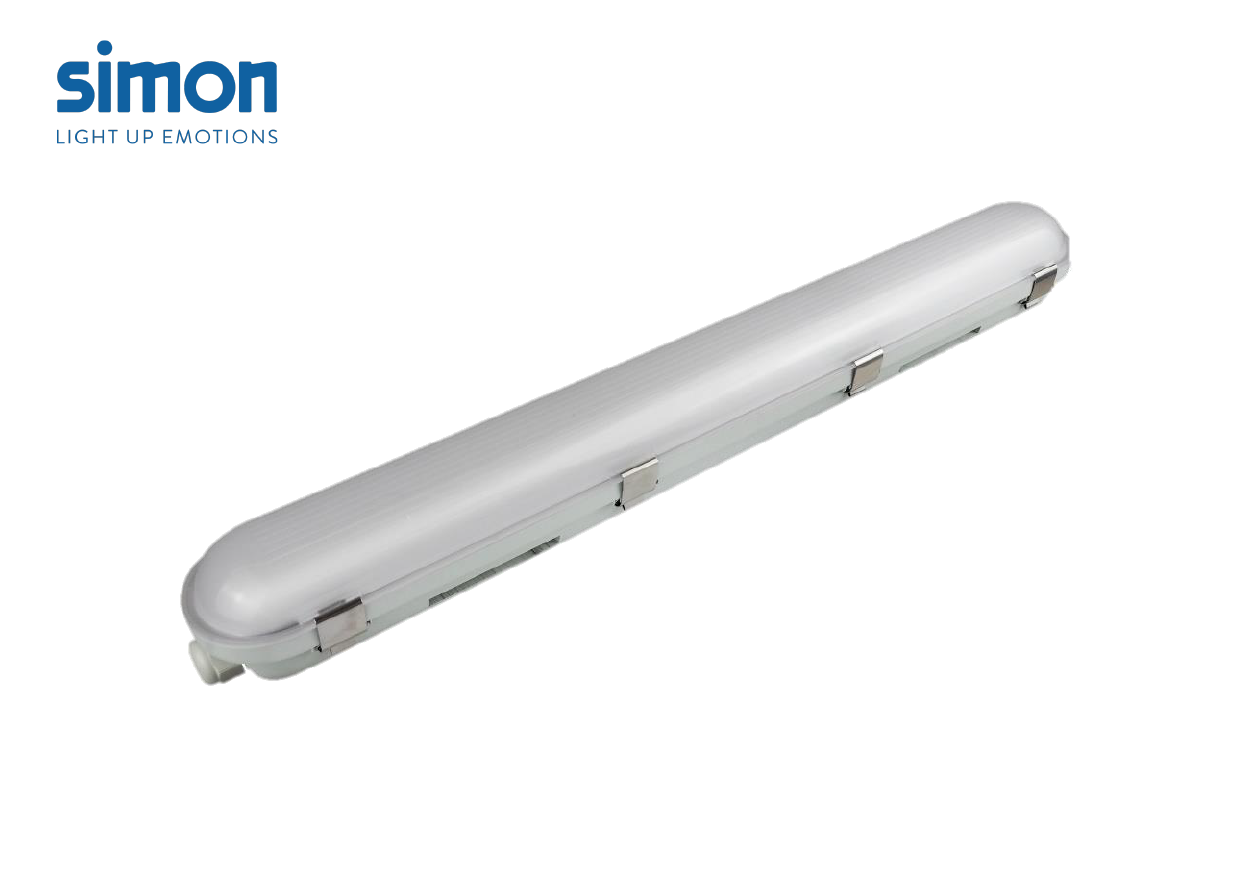
WP26 LED Waterproof Batten Light

The WP26 LED Waterproof Batten Light is a high-efficiency, durable lighting solution designed for industrial, commercial, and outdoor environments. With an outstanding luminous efficacy of up to 150 lm/W, the WP26 delivers maximum brightness with minimal energy consumption.

Built with IP65 waterproof and dustproof protection, robust polycarbonate housing, and stainless steel clips, the WP26 ensures long-term reliability even in harsh conditions such as car parks, warehouses, corridors, workshops, and plant rooms.

The luminaire offers multiple wattage options from 10W to 48W, 4000K or 6500K colour temperature, and surface or pendant installation. With a 50,000-hour lifetime, flicker-free driver, and optional emergency (EM) function, WP26 is a cost-effective and maintenance-friendly lighting solution.

Key Features & Benefits

  • Ultra-high efficiency up to 150 lm/W
  • IP65 waterproof & dustproof – suitable for harsh environments
  • Robust polycarbonate housing with stainless steel metal clips
  • Wide wattage range: 10W / 18W / 36W / 48W
  • Colour temperature options: 4000K & 6500K

Feature WP26 LED Batten Light
Power Consumption 10W | 18W | 36W | 48W
Luminous Efficacy Up to 150 lm/W
Colour Rendering Index (CRI) ≥80
UGR <19
Input Voltage 220-240
Power Factor (PF) ≥ 0.9
Beam Angle 120°
Dimmable No
THD (%) < 15
IP Rating IP65
Product Code Description Power (W) Luminance (lm) CCT
N05E0-0180 WP26 LED WEATHERPROOF 10W4000K 600 10 1,500 4000K
N05E0-0183 WP26 LED WEATHERPROOF 18W6500K 1200 18 2,700 6500K
N05E0-0185 WP26 LED WEATHERPROOF 36W6500K 1200 36 5,400 6500K
N05E0-0187 WP26 LED WEATHERPROOF 48W6500K 1500 48 7,200 6500K
Feature CD20A SMD DownLight
Materials Polycarbonate & Stainless Steel
Driver Constant Current
Life Time (hours) 50,000
Finishing Color Grey / White
Operating Temp (°C) -20°C to +40°C
Storage Temp (°C) -30°C to +80°C

Indoor or interior lighting

Indoor lighting for a building is the light source that is being integrated into the inner of the building for some general purpose such as brighten the room and give some special or desired effect to the room. The lighting in a home will changes the mood of person in the room just as it does the perceived size of a room. The lighting in a room either provides illumination for the entirety of the room, it highlights very specific elements. Fixture, placement and type of lighting are all the important aspects of indoor design, and they work in conjunction with color selections, size, availability of natural light and furniture selection. The elements that come together when the right lighting is achieved and this can transform a room into a seamless combination of functionality and style.

How indoor lighting affect us

There is a lots of research says that the effect of indoor light has on our emotional system. This is because the light will being perceived as heat, and the perception of heat can trigger our emotions. Beside that, indoor lighting regulates a lot of human behaviors and activities such as sleep and attentiveness. Research have state that students who study in environments with the natural day lighting can increase in their academic performance. Natural light is always preferred but not always attainable in a classroom or work environment. So, indoor light have affect us in our daily light, we need to be more careful when dealing with the purchasing and installation of indoor light.

RECESSED LED DOWN LIGHT IP65

A LED Recessed light or LED Downlight (also pot light in Canadian English, sometimes can light (for canister light) in American English) is a light fixture that is installed into a hollow opening in a ceiling. When installed it appears to have light shining from a hole in the ceiling, concentrating the light in a downward direction as a broad floodlight or narrow spotlight. Malaysia
“Pot light” or “canister light” implies the hole is circular and the lighting fixture is cylindrical, like a pot or canister.
There are three parts to a recessed lighting fixture: housing, trim and bulb. The trim is the visible portion of the light. It is the insert that is seen when looking up into the fixture, and also includes the thin lining around the edge of the light. The housing is the fixture itself that is installed inside the ceiling and contains the lamp holder. There are many different types of bulbs that can be inserted into recessed lighting fixtures, with the amount of heat generated by the bulb being a unique consideration.

In North America, UL 1598 recessed housings generally fall into one of four categories.

IC or “insulation contact” rated new construction housings are attached to the ceiling supports before the ceiling surface is installed. If the area above the ceiling is accessible these fixtures may also be installed from within the attic space. IC housings must be installed wherever insulation will be in direct contact with the housing.
Non-IC rated new construction housings are used in the same situations as the IC rated new construction housings, only they require that there be no contact with insulation and at least 3 in (7.6 cm) spacing from insulation. These housings are typically rated up to 150 watts.
IC rated remodel housings are used in existing ceilings where insulation will be present and in contact with the fixture.
Non-IC rated remodel housings are used for existing ceilings where, ideally, no insulation is present. However, these also require that there be no contact with insulation and at least 3 in (7.6 cm) spacing from insulation. Sloped-ceiling housings are available for both insulated and non-insulated ceilings that are vaulted.
The main feature of the housing is designed to ensure that no flammable materials come into contact with the hot lighting fixture. Badly-housed downlights can be a fire hazard, though all newer ones contain a self-resetting thermal switch for safety.

The housings come in various sizes based on the diameter of the circular opening where the lamp is installed. The most commonly used sizes are 4, 5 and 6 inches in diameter, with 4 inch IC New Construction units less readily available at present. Smaller housings (2 and 3 inch) are also available for specialized uses.

The housing can also be “Air Tight”, which means it will not allow air to escape into the ceiling or attic, thus reducing both heating and cooling costs.

The City of Chicago has an additional requirement “Chicago Plenum” which requires the housing to be airtight in addition to requiring all wiring and to be sealed off and gasketed from the plenum air space. This housing rating must be used on all recessed luminaires installed in air plenums in the City of Chicago as well as nearby municipalities which have adopted the Chicago amendments to the NEC. The intent of this rating is to prevent potential sparks from escaping the luminaire into the air plenum and getting recirculated in the HVAC system

Indoor Lighting Technology Trend In Fourth Industry Revolution

1) Connectivity–With LEDs comprehensively in the mainstream, the next frontier in lighting is controls. Call it smart, call it connected, call it what you like – the point is that your lights can be controlled. Controller and sensors have been around for donkey’s years, but the challenge now is to make them more sophisticated, get them to communicate with other devices and make sure people use them to perform more and more task.

2) The internet of things (IoT)-There are only computer , smart-phone and other smart device can be connected to web. With the internet of things(IoT) technology,  it’s no longer just computers and smart-phones that are connected to the web, but also your clothes, your coffee cup, your heart monitor and your LED lights. Lighting is an ideal network for internet-of-things services to be built on – because it’s already there in the ceiling of every building, looking down at us, wired up and ready to go. You only have to add a few sensors or controller so that it can make some data connection with other user.

3) Built-in light sources–Because LED light sources have good quality, so it don’t have to be replaced very often, and because no standards have emerged for what they should be like, manufacturers have got used to building them into fittings, rather than designing new luminaires around replaceable ‘lamps’. But what happens if they fail early? Or a better, more efficient module comes on the market? Organisations such as Zhaga have sought to address the issue by coming up with agreed designs, but integrated modules are becoming the norm. Will we regret lumbering our clients with light sources they can’t change?